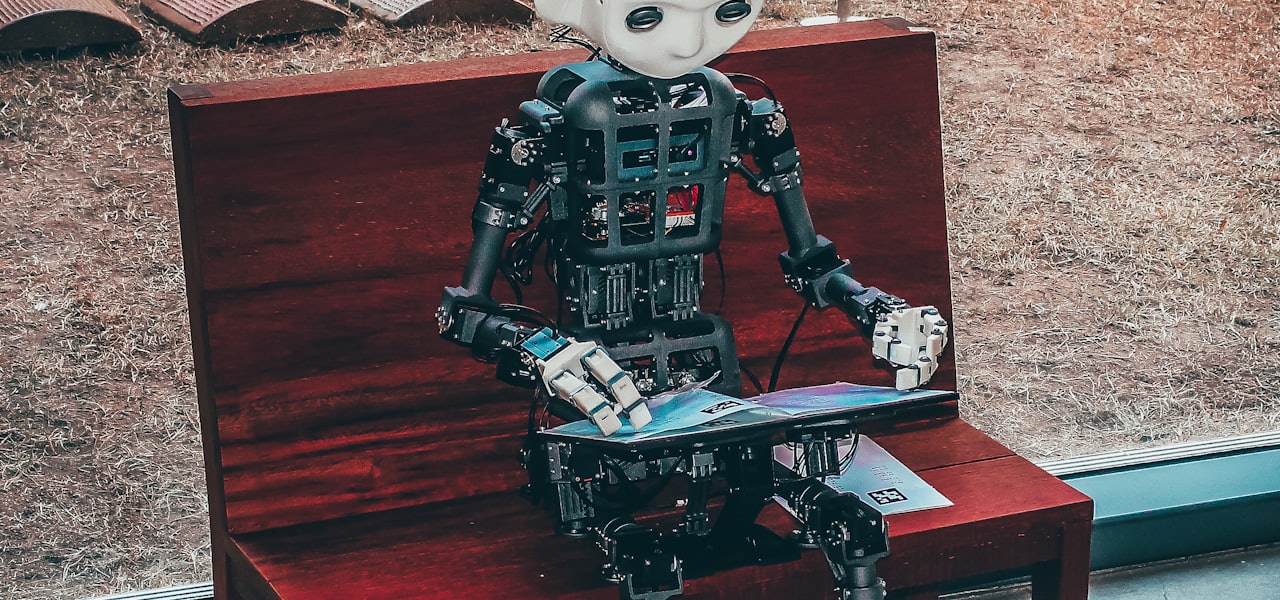
Science Fiction Thinking Machines: Robots, Androids, Computers is an anthology of science fiction short stories edited by American anthologist Groff Conklin. It was first published in hardcover by Vanguard Press in May 1954. An abridged paperback edition titled, Selections from Science Fiction Thinking Machines was later published by Bantam Books in August 1955 and was reprinted in September 1964. The book consists of twenty-two novelettes and short stories by various science fiction authors, together with an introduction and bibliography by the editor. The stories were previously published from 1899-1954, in various science fiction and other magazines. == Contents == Note: stories also appearing in the abridged edition annotated A. "Introduction" (Groff Conklin) "Automata: I" (S. Fowler Wright) "Moxon's Master" (Ambrose Bierce) "Robbie" (Isaac Asimov) A "The Scarab" (Raymond Z. Gallun) "The Mechanical Bride" (Fritz Leiber) "Virtuoso" (Herbert Goldstone) A "Automata: II" (S. Fowler Wright) "Boomerang" (Eric Frank Russell) A "The Jester" (William Tenn) A "R. U. R." (Karel Čapek) "Skirmish" (Clifford D. Simak) A "Soldier Boy" (Michael Shaara) "Automata: III" (S. Fowler Wright) "Men Are Different" (Alan Bloch) A "Letter to Ellen" (Chan Davis) A "Sculptors of Life" (Wallace West) "The Golden Egg" (Theodore Sturgeon) A "Dead End" (Wallace Macfarlane) A "Answer" (Hal Clement) "Sam Hall" (Poul Anderson) A "Dumb Waiter" (Walter M. Miller Jr.) A "Problem for Emmy" (Robert Sherman Townes) A "Selected List of Tales About Robots, Androids, and Computers" (Groff Conklin)
Human–robot interaction
Human–robot interaction (HRI) is the study of interactions between humans and robots. Human–robot interaction is a multidisciplinary field with contributions from human–computer interaction, artificial intelligence, robotics, natural language processing, design, psychology and philosophy. A subfield known as physical human–robot interaction (pHRI) has tended to focus on device design to enable people to safely interact with robotic systems. == Origins == Human–robot interaction has been a topic of both science fiction and academic speculation even before any robots existed. Because much of active HRI development depends on natural language processing, many aspects of HRI are continuations of human communications, a field of research which is much older than robotics. The origin of HRI as a discrete problem was stated by 20th-century author Isaac Asimov in 1941, in his novel I, Robot. Asimov coined Three Laws of Robotics, namely: A robot may not injure a human being or, through inaction, allow a human being to come to harm. A robot must obey the orders given it by human beings except where such orders would conflict with the First Law. A robot must protect its own existence as long as such protection does not conflict with the First or Second Laws. These three laws provide an overview of the goals engineers and researchers hold for safety in the HRI field, although the fields of robot ethics and machine ethics are more complex than these three principles. However, generally human–robot interaction prioritizes the safety of humans that interact with potentially dangerous robotics equipment. Solutions to this problem range from the philosophical approach of treating robots as ethical agents (individuals with moral agency), to the practical approach of creating safety zones. These safety zones use technologies such as lidar to detect human presence or physical barriers to protect humans by preventing any contact between machine and operator. Although initially robots in the human–robot interaction field required some human intervention to function, research has expanded this to the extent that fully autonomous systems are now far more common than in the early 2000s. Autonomous systems include from simultaneous localization and mapping systems which provide intelligent robot movement to natural-language processing and natural-language generation systems which allow for natural, human-esque interaction which meet well-defined psychological benchmarks. Anthropomorphic robots (machines which imitate human body structure) are better described by the biomimetics field, but overlap with HRI in many research applications. Examples of robots which demonstrate this trend include Willow Garage's PR2 robot, the NASA Robonaut, and Honda ASIMO. However, robots in the human–robot interaction field are not limited to human-like robots: Paro and Kismet are both robots designed to elicit emotional response from humans, and so fall into the category of human–robot interaction. Goals in HRI range from industrial manufacturing through Cobots, medical technology through rehabilitation, autism intervention, and elder care devices, entertainment, human augmentation, and human convenience. Future research therefore covers a wide range of fields, much of which focuses on assistive robotics, robot-assisted search-and-rescue, and space exploration. == The goal of friendly human–robot interactions == Robots are artificial agents with capacities of perception and action in the physical world often referred by researchers as workspace. Their use has been generalized in factories but nowadays they tend to be found in the most technologically advanced societies in such critical domains as search and rescue, military battle, mine and bomb detection, scientific exploration, law enforcement, entertainment and hospital care. These new domains of applications imply a closer interaction with the user, sharing the workspace but also goals in terms of task achievement. The subfield of physical human–robot interaction (pHRI) has largely focused on device design to enable people to safely interact with robotic systems but is increasingly developing algorithmic approaches in an attempt to support fluent and expressive interactions between humans and robotic systems. With the advance in AI, the research is focusing on one part towards the safest physical interaction but also on a socially correct interaction, dependent on cultural criteria. The goal is to build an intuitive, and easy communication with the robot through speech, gestures, and facial expressions. Kerstin Dautenhahn refers to friendly Human–robot interaction as "Robotiquette" defining it as the "social rules for robot behaviour (a 'robotiquette') that is comfortable and acceptable to humans" The robot has to adapt itself to our way of expressing desires and orders and not the contrary. But every day environments such as homes have much more complex social rules than those implied by factories or even military environments. Thus, the robot needs perceiving and understanding capacities to build dynamic models of its surroundings. It needs to categorize objects, recognize and locate humans and further recognize their emotions. The need for dynamic capacities pushes forward every sub-field of robotics. Furthermore, by understanding and perceiving social cues, robots can enable collaborative scenarios with humans. For example, with the rapid rise of personal fabrication machines such as desktop 3D printers, laser cutters, etc., entering our homes, scenarios may arise where robots can collaboratively share control, co-ordinate and achieve tasks together. Industrial robots have already been integrated into industrial assembly lines and are collaboratively working with humans. The social impact of such robots have been studied and has indicated that workers still treat robots and social entities, rely on social cues to understand and work together. On the other end of HRI research the cognitive modelling of the "relationship" between human and the robots benefits the psychologists and robotic researchers the user study are often of interests on both sides. This research endeavours part of human society. For effective human – humanoid robot interaction numerous communication skills and related features should be implemented in the design of such artificial agents/systems. == General HRI research == HRI research spans a wide range of fields, some general to the nature of HRI. === Methods for perceiving humans === Methods for perceiving humans in the environment are based on sensor information. Research on sensing components and software led by Microsoft provide useful results for extracting the human kinematics (see Kinect). An example of older technique is to use colour information for example the fact that for light skinned people the hands are lighter than the clothes worn. In any case a human modelled a priori can then be fitted to the sensor data. The robot builds or has (depending on the level of autonomy the robot has) a 3D mapping of its surroundings to which is assigned the humans locations. Most methods intend to build a 3D model through vision of the environment. The proprioception sensors permit the robot to have information over its own state. This information is relative to a reference. Theories of proxemics may be used to perceive and plan around a person's personal space. A speech recognition system is used to interpret human desires or commands. By combining the information inferred by proprioception, sensor and speech the human position and state (standing, seated). In this matter, natural-language processing is concerned with the interactions between computers and human (natural) languages, in particular how to program computers to process and analyze large amounts of natural-language data. For instance, neural-network architectures and learning algorithms that can be applied to various natural-language processing tasks including part-of-speech tagging, chunking, named-entity recognition, and semantic role labeling. === Methods for motion planning === Motion planning in dynamic environments is a challenge that can at the moment only be achieved for robots with 3 to 10 degrees of freedom. Humanoid robots or even 2 armed robots, which can have up to 40 degrees of freedom, are unsuited for dynamic environments with today's technology. However lower-dimensional robots can use the potential field method to compute trajectories which avoid collisions with humans. === Cognitive models and theory of mind === Humans exhibit negative social and emotional responses as well as decreased trust toward some robots that closely, but imperfectly, resemble humans; this phenomenon has been termed the "Uncanny Valley". However recent research in telepresence robots has established that mimicking human body postures and expressive gestures has made the robots likeable and engaging in a remote setting. Further, the presence o
CrySyS Lab
CrySyS Lab (Hungarian pronunciation: [ˈkriːsis]) is part of the Department of Telecommunications at the Budapest University of Technology and Economics. The name is derived from "Laboratory of Cryptography and System Security", the full Hungarian name is CrySys Adat- és Rendszerbiztonság Laboratórium. == History == CrySyS Lab. was founded in 2003 by a group of security researchers at the Budapest University of Technology and Economics. Currently, it is located in the Infopark Budapest. The heads of the lab were Dr. István Vajda (2003–2010) and Dr. Levente Buttyán (2010-now). Since its establishment, the lab participated in several research and industry projects, including successful EU FP6 and FP7 projects (SeVeCom, a UbiSecSens and WSAN4CIP). == Research results == CrySyS Lab is recognized in research for its contribution to the area of security in wireless embedded systems. In this area, the members of the lab produced 5 books 4 book chapters 21 journal papers 47 conference papers 3 patents 2 Internet Draft The above publications had an impact factor of 30+ and obtained more than 7500 references. Several of these publications appeared in highly cited journals (e.g., IEEE Transactions on Dependable and Secure Systems, IEEE Transactions on Mobile Computing). == Forensics analysis of malware incidents == The laboratory was involved in the forensic analysis of several high-profile targeted attacks. In October 2011, CrySyS Lab discovered the Duqu malware; pursued the analysis of the Duqu malware and as a result of the investigation, identified a dropper file with an MS 0-day kernel exploit inside; and finally released a new open-source Duqu Detector Toolkit to detect Duqu traces and running Duqu instances. In May 2012, the malware analysis team at CrySyS Lab participated in an international collaboration aiming at the analysis of an as yet unknown malware, which they call sKyWIper. At the same time Kaspersky Lab analyzed the malware Flame and Iran National CERT (MAHER) the malware Flamer. Later, they turned out to be the same. Other analysis published by CrySyS Lab include the password analysis of the Hungarian ISP, Elender, and a thorough Hungarian security survey of servers after the publications of the Kaminsky DNS attack.
Social media use in the fashion industry
Social media in the fashion industry refers to the use of social media platforms by fashion designers and users to promote and participate in trends. Over the past several decades, the development of social media has increased along with its usage by consumers. The COVID-19 pandemic was a sharp turn of reliance on the virtual sphere for the industry and consumers alike. Social media has created new channels of advertising for fashion houses to reach their target markets. Since its surge in 2009, luxury fashion brands have used social media to build interactions between the brand and its customers to increase awareness and engagement. The emergence of influencers on social media has created a new way of advertising and maintaining customer relationships in the fashion industry. Numerous social media platforms are used to promote fashion trends, with Instagram and TikTok being the most popular among Generation Y and Z. The overall impact of social media in the fashion industry included the creation of online communities, direct communication between industry leaders and consumers, and criticized ideals that are promoted by the industry through social media. == Background == In 2003, at the beginning of social media development, MySpace was founded as a “social networking service.” It allowed people to create a profile, connect with other people, and post videos, pictures, and songs. As MySpace grew in popularity, it attracted interest from companies wishing to promote their brands on the social platform. MySpace is most well known for exposing musicians and artists who made it big in the industry, and companies wanted to capitalize on their popularity by making brand deals. One of MySpace's deals was with Chevrolet, putting on a ‘secret show’. They had a ‘secret’ list of 10 top artists on MySpace, and many artists posted about the show on their accounts. Another brand deal was with Gucci promoting their “Gucci Synch Watch”, which was very successful as Gucci tapped into the youthful audience on MySpace and advertised a sleek, simple, trendy unisex watch. In 2005, YouTube was released and remains one of the most popular social media platforms today. YouTube allows users to upload videos and is free to anyone with access to the internet. It grew in popularity offering a range of videos: vlogs, cooking, health and diet videos, step-by-step tutorials, tutoring help, and more. Much like MySpace, users create accounts and can build a following, often referring to themselves as ‘YouTubers.’ When YouTube grew in popularity, it piqued the interest of brands wanting to partner with YouTube and individual YouTubers. Some brand deals were made by having ads at the beginning of each video, and the YouTuber would make a profit from each view they receive. Some deals are made by individual YouTubers thanking the brand in videos and promoting the brand's products. More recently, YouTube has delved into fashion. While there were always YouTube channels for Vogue and other fashion companies, popular YouTubers have been invited to different fashion shows and have filmed experiences there. Brands are able to target individual YouTubers based on their followers and the target audiences. In 2010, Instagram was launched, which enlarged the scope of fashion advertising. Instagram allows people to post pictures and short videos with the ability to tag different accounts. For brand deals, companies can simply be tagged in a picture instead of creating ads or lines for a user to say. In each picture, users can tag the brands of clothing they were wearing, making it very easy to promote brands. Additionally, Instagram could display ads on users' feed based on other posts the users liked, which used by fashion companies to target their potential customers. Users also use Instagram to promote fashion when they get invited to fashion events. For example, they can take a picture at the event and post it to their Instagram and put their location at the venue and tag the company. During the beginning of the COVID-19 pandemic, companies relied more on social media to keep their public virtually engaged. Fashion companies had virtual fashion shows, creating videos and content about their designs. As social media expands and new platforms come into existence, new ways of advertising are projected to be created. == Uses == === Advertising === Social media is a popular use of advertisement in the fashion industry. Information sharing has expanded due to the growth of social media platforms, which impacts social consumer involvement with fashion brands. Fashion companies use social media platforms to reach customers on emotional levels and stoke engagement with brand images and messages. Researchers in the United Kingdom have demonstrated that engaging with customers with social media messages that express social passion, social tendency, and personal warmth can boost social engagement with fashion brands. In social spheres, fashion is a method for individuals to represent their distinction through clothing. Some people who desire to socially influence others through their fashion and style now have the possibility thanks to social media in the fashion sector. Customers who want to purchase fashion brands frequently follow fashion authorities on social media and heed their recommendations for purchasing fashion products. === Influencers === Companies leveraged celebrities' fame and social standing to advertise their brands, as Tommy Hilfiger did when incorporating social media into their marketing strategy, making Gigi Hadid, who has 15.5 million Instagram followers as of 2016, a brand ambassador. Though recent developments in social media platforms have led to an increase in the awareness of influencers. Influencer marketing has emerged as a fast expanding marketing strategy in various industries as a result of the unheard-of increase in the number of social media influencers' followers. Recently, influencer marketing has received significant attention in the fashion industry. Research shows that influencer marketing may provide a rate of influence that is 11x times greater than that of other conventional advertising channels. Fashion consumers, specifically those in generations Y and Z, may be more influenced by influencers in the context of the fashion industries as they often view them as friends and personal assistants. Fashion influencer marketing on social media platforms have led fashion consumption on social sopping services. One of these social fashion services is LTK (LIKEtoKNOW.it before 2021) where everyday consumers can find and purchase clothing worn by social media fashion influencers (also known as SMFIs). Launched in 2014, LTK has gained a massive following on Instagram (over 3 million) and has 1.3 million registered users on their mobile application. Utilizing SMFIs has led to massive sales within the fashion industry, 80% of visitors of Nordstrom's mobile platform are referred by influencers. Social media fashion influencers try new fashion products, adopt fashion trends and have power in what their audience purchases. Social media fashion influencers gain a following though promoting fashion products, and posting about their lavish lifestyles attained through their higher socioeconomic status. The attractive lifestyles of the influencers influence their followers to mimic their luxurious lifestyle and are allowed to consume the same products through social shopping services. In addition to brands themselves having direct access to social media users, many content creators have great influence over consumers. "Influencers" across all social media platforms have great power when it comes to where people shop and what they purchase. Influencer marketing has become one of the most effective marketing strategies for many fashion brands. These brand deals and creator partnerships are targeted towards Millennial and Gen Z consumers, specifically on Instagram and TikTok, and 74% of consumers have made a purchase simply because an influencer they follow had recommended it. === Trends === The connection between social media and fashion has become common. Influencer marketing has emerged as a necessity and crucial component of advertising. 85% of American businesses are presently using influencer marketing as part of their marketing plan. Wearing fashion brands is a method to show oneself at social gatherings. Through their clothing, people try to demonstrate how distinct they are. Some people who really desire to socially influence others through their fashion and style now have the possibility thanks to social media in the fashion sector. Customers who want to purchase fashion brands frequently follow fashion authorities on social media and heed their recommendations for purchasing fashion products. In January 2021, the Italian fashion house Bottega Veneta deleted all its social media accounts "to lean much more on its ambassadors and fans" to spread the com
Trusted Computing
Trusted Computing (TC) is a technology developed and promoted by the Trusted Computing Group. The term is taken from the field of trusted systems and has a specialized meaning that is distinct from the field of confidential computing. With Trusted Computing, the computer will consistently behave in expected ways, and those behaviors will be enforced by computer hardware and software. Enforcing this behavior is achieved by loading the hardware with a unique encryption key that is inaccessible to the rest of the system and the owner. TC is controversial as the hardware is not only secured for its owner, but also against its owner, leading opponents of the technology like free software activist Richard Stallman to deride it as "treacherous computing", and certain scholarly articles to use scare quotes when referring to the technology. Trusted Computing proponents such as International Data Corporation, the Enterprise Strategy Group and Endpoint Technologies Associates state that the technology will make computers safer, less prone to viruses and malware, and thus more reliable from an end-user perspective. They also state that Trusted Computing will allow computers and servers to offer improved computer security over that which is currently available. Opponents often state that this technology will be used primarily to enforce digital rights management policies (imposed restrictions to the owner) and not to increase computer security. Chip manufacturers Intel and AMD, hardware manufacturers such as HP and Dell, and operating system providers such as Microsoft include Trusted Computing in their products if enabled. The U.S. Army requires that every new PC it purchases comes with a Trusted Platform Module (TPM). As of July 3, 2007, so does virtually the entire United States Department of Defense. == Key concepts == Trusted Computing encompasses six key technology concepts, of which all are required for a fully Trusted system, that is, a system compliant to the TCG specifications: Endorsement key Secure input and output Memory curtaining / protected execution Sealed storage Remote attestation Trusted Third Party (TTP) === Endorsement key === The endorsement key is a 2048-bit RSA public and private key pair that is created randomly on the chip at manufacture time and cannot be changed. The private key never leaves the chip, while the public key is used for attestation and for encryption of sensitive data sent to the chip, as occurs during the TPM_TakeOwnership command. This key is used to allow the execution of secure transactions: every Trusted Platform Module (TPM) is required to be able to sign a random number (in order to allow the owner to show that he has a genuine trusted computer), using a particular protocol created by the Trusted Computing Group (the direct anonymous attestation protocol) in order to ensure its compliance of the TCG standard and to prove its identity; this makes it impossible for a software TPM emulator with an untrusted endorsement key (for example, a self-generated one) to start a secure transaction with a trusted entity. The TPM should be designed to make the extraction of this key by hardware analysis hard, but tamper resistance is not a strong requirement. === Memory curtaining === Memory curtaining extends common memory protection techniques to provide full isolation of sensitive areas of memory—for example, locations containing cryptographic keys. Even the operating system does not have full access to curtained memory. The exact implementation details are vendor specific. === Sealed storage === Sealed storage protects private information by binding it to platform configuration information including the software and hardware being used. This means the data can be released only to a particular combination of software and hardware. Sealed storage can be used for DRM enforcing. For example, users who keep a song on their computer that has not been licensed to be listened will not be able to play it. Currently, a user can locate the song, listen to it, and send it to someone else, play it in the software of their choice, or back it up (and in some cases, use circumvention software to decrypt it). Alternatively, the user may use software to modify the operating system's DRM routines to have it leak the song data once, say, a temporary license was acquired. Using sealed storage, the song is securely encrypted using a key bound to the trusted platform module so that only the unmodified and untampered music player on his or her computer can play it. In this DRM architecture, this might also prevent people from listening to the song after buying a new computer, or upgrading parts of their current one, except after explicit permission of the vendor of the song. === Remote attestation === Remote attestation allows changes to the user's computer to be detected by authorized parties. For example, software companies can identify unauthorized changes to software, including users modifying their software to circumvent commercial digital rights restrictions. It works by having the hardware generate a certificate stating what software is currently running. The computer can then present this certificate to a remote party to show that unaltered software is currently executing. Numerous remote attestation schemes have been proposed for various computer architectures, including Intel, RISC-V, and ARM. Remote attestation is usually combined with public-key encryption so that the information sent can only be read by the programs that requested the attestation, and not by an eavesdropper. To take the song example again, the user's music player software could send the song to other machines, but only if they could attest that they were running an authorized copy of the music player software. Combined with the other technologies, this provides a more restricted path for the music: encrypted I/O prevents the user from recording it as it is transmitted to the audio subsystem, memory locking prevents it from being dumped to regular disk files as it is being worked on, sealed storage curtails unauthorized access to it when saved to the hard drive, and remote attestation prevents unauthorized software from accessing the song even when it is used on other computers. To preserve the privacy of attestation responders, Direct Anonymous Attestation has been proposed as a solution, which uses a group signature scheme to prevent revealing the identity of individual signers. Proof of space (PoS) have been proposed to be used for malware detection, by determining whether the L1 cache of a processor is empty (e.g., has enough space to evaluate the PoSpace routine without cache misses) or contains a routine that resisted being evicted. === Trusted third party === == Known applications == The Microsoft products Windows Vista, Windows 7, Windows 8 and Windows RT make use of a Trusted Platform Module to facilitate BitLocker Drive Encryption. Other known applications with runtime encryption and the use of secure enclaves include the Signal messenger and the e-prescription service ("E-Rezept") by the German government. == Possible applications == === Digital rights management === Trusted Computing would allow companies to create a digital rights management (DRM) system which would be very hard to circumvent, though not impossible. An example is downloading a music file. Sealed storage could be used to prevent the user from opening the file with an unauthorized player or computer. Remote attestation could be used to authorize play only by music players that enforce the record company's rules. The music would be played from curtained memory, which would prevent the user from making an unrestricted copy of the file while it is playing, and secure I/O would prevent capturing what is being sent to the sound system. Circumventing such a system would require either manipulation of the computer's hardware, capturing the analogue (and thus degraded) signal using a recording device or a microphone, or breaking the security of the system. New business models for use of software (services) over Internet may be boosted by the technology. By strengthening the DRM system, one could base a business model on renting programs for a specific time periods or "pay as you go" models. For instance, one could download a music file which could only be played a certain number of times before it becomes unusable, or the music file could be used only within a certain time period. === Preventing cheating in online games === Trusted Computing could be used to combat cheating in online games. Some players modify their game copy in order to gain unfair advantages in the game; remote attestation, secure I/O and memory curtaining could be used to determine that all players connected to a server were running an unmodified copy of the software. === Verification of remote computation for grid computing === Trusted Computing could be used to guarantee participants in a grid computing sys
Spanner (database)
Spanner is a distributed SQL database management and storage service developed by Google. It provides features such as global transactions, strongly consistent reads, and automatic multi-site replication and failover. Spanner is used in Google F1, the database for its advertising business Google Ads, as well as Gmail and Google Photos. == Features == Spanner stores large amounts of mutable structured data. Spanner allows users to perform arbitrary queries using SQL with relational data while maintaining strong consistency and high availability for that data with synchronous replication. Key features of Spanner: Transactions can be applied across rows, columns, tables, and databases within a Spanner universe. Clients can control the replication and placement of data using automatic multi-site replication and failover. Replication is synchronous and strongly consistent. Reads are strongly consistent and data is versioned to allow for stale reads: clients can read previous versions of data, subject to garbage collection windows. Supports a native SQL interface for reading and writing data. Support for Graph Query Language == History == Spanner was first described in 2012 for internal Google data centers. Spanner's SQL capability was added in 2017 and documented in a SIGMOD 2017 paper. It became available as part of Google Cloud Platform in 2017, under the name "Cloud Spanner". == Architecture == Spanner uses the Paxos algorithm as part of its operation to shard (partition) data across up to hundreds of servers. It makes heavy use of hardware-assisted clock synchronization using GPS clocks and atomic clocks to ensure global consistency. TrueTime is the brand name for Google's distributed cloud infrastructure, which provides Spanner with the ability to generate monotonically increasing timestamps in data centers around the world. Google's F1 SQL database management system (DBMS) is built on top of Spanner, replacing Google's custom MySQL variant.
CANaerospace
CANaerospace is a higher layer protocol based on Controller Area Network (CAN) which has been developed by Stock Flight Systems in 1998 for aeronautical applications. == Background == CANaerospace supports airborne systems employing the Line-replaceable unit (LRU) concept to share data across CAN and ensures interoperability between CAN LRUs by defining CAN physical layer characteristics, network layers, communication mechanisms, data types and aeronautical axis systems. CANaerospace is an open source project, was initiated to standardize the interface between CAN LRUs on the system level. CANaerospace is continuously being developed further and has also been published by NASA as the Advanced General Aviation Transport Experiments Databus Standard in 2001. It found widespread use in aeronautical research worldwide. A major research aircraft that employs several CANaerospace networks for real-time computer interconnection is the Stratospheric Observatory for Infrared Astronomy (SOFIA), a Boeing 747SP with a 2.5m astronomic telescope. CANaerospace is also frequently used in flight simulation and connects entire aircraft cockpits (i.e. in Eurofighter Typhoon simulators) to the simulation host computers. In Italy CANaerospace is used as UAV data bus technology. Furthermore, CANaerospace serves as communication network in several general aviation avionics systems. The CANaerospace interface definition closes the gap between the ISO/OSI layer 1 and 2 CAN protocol (which is implemented in the CAN controller itself) and the specific requirements of distributed systems in aircraft. It may be used as a primary or ancillary avionics network and was designed to meet the following requirements: Democratic network: CANaerospace does not require any master/slave relationships between LRUs or a "bus controller", thereby avoiding a potential single source of failure. Every node in the network has the same rights for participation in the bus traffic. Self-identifying message format: Each CANaerospace message contains information about the type of the data and the transmitting node. This allows the data to be unambiguously recognized at each receiving node. Continuous Message Numbering: Each CANaerospace message contains a continuously incremented number which allows coherent processing of messages in the receiving stations. Message Status Code: Each CANaerospace message contains information about the integrity of the data is conveying. This allows receiving stations to evaluate the quality of the received data and to react accordingly. Emergency Event Signaling: CANaerospace defines a mechanism that allows each node to transmit information about exception or error situations. This information can be used by other stations to determine the network health. Node Service Interface: As an enhancement to CAN, CANaerospace provides a means for individual stations on the network to communicate with each other using connection-oriented and connectionless services. Predefined CAN Identifier Assignment: CANaerospace offers a predefined identifier assignment list for normal operation data. In addition to the predefined list, user-defined identifier assignment lists may be used. Ease of Implementation: The amount of code to implement CANaerospace is very little by design in order to minimize the effort for testing and certification of flight safety critical systems. Openness to Extensions: All CANaerospace definitions are extendable to provide flexibility for future enhancements and to allow adaptions to the requirements of specific applications. Free Availability: No cost whatsoever apply for the use of CANaerospace. The specification can be downloaded from the Internet == Physical interface == To ensure interoperability and reliable communication, CANaerospace specifies the electrical characteristics, bus transceiver requirements and data rates with the corresponding tolerances based on ISO 11898. The bit timing calculation (baud rate accuracy, sample point definition) and robustness to electromagnetic interference are given special emphasis. Also addressed are CAN connector, wiring considerations and design guidelines to maximize electromagnetic compatibility. == Communication layers == The Bosch CAN specification itself allows messages being transmitted both periodically and aperiodically but does not cover issues like data representation, node addressing or connection-oriented protocols. CAN is entirely based on Anyone-to-Many (ATM) communication which means that CAN messages are always received by all stations in the network. The advantage of the CAN concept is inherent data consistency between all stations, the drawback is that it does not allow node addressing which is the basis for Peer-to-Peer (PTP) communication. Using CAN networks in aeronautical applications, however, demands a standard targeted to the specific requirements of airborne systems which implies that communication between individual stations in the network must be possible to enable the required degree of system monitoring. Consequently, CANaerospace defines additional ISO/OSI layer 3, 4 and 6 functions to support node addressing and unified ATM/PTP communication mechanisms. PTP communication allows to set up client/server interactions between individual stations in the network either temporarily or permanently. More than one of these interactions may be in effect at any given time and each node may be client for one operation and server for another at the same time. This CANaerospace mechanism is called "Node Service Concept" and allows i.e. to distribute system functions over several stations in the network or to control dynamic system reconfiguration in case of failure. The Node Service concept supports both connection-oriented and connectionless interactions like with TCP/IP and UDP/IP for Ethernet. Enabling both ATM and PTP communication for CAN requires the introduction of independent network layers to isolate the different types of communication. This is realized for CANaerospace by forming CAN identifier groups as shown in Figure 1. The resulting structure creates Logical Communication Channels (LCCs) and assigns a specific communication type (ATM, PTP) to each of the LCCs. User-defined LCCs provide the necessary freedom for designers and allow the implementation of CANaerospace according to the needs of specific applications. Figure 1: Logical Communication Channels for CANaerospace As a side effect, the CAN identifier groups in Figure 1 affect the priority of the message transmission in case of bus arbitration. The communication channels are therefore arranged according to their relative importance: Emergency Event Data Channel (EED): This communication channel is used for messages which require immediate action (i.e. system degradation or reconfiguration) and have to be transmitted with very high priority. Emergency Event Data uses ATM communication exclusively. High/Low Priority Node Service Data Channel (NSH/NSL): These communication channels are used for client/server interactions using PTP communication. The corresponding services may be of the connection-oriented as well as the connectionless type. NSH/NSL may also be used to support test and maintenance functions. Normal Operation Data Channel (NOD): This communication channel is used for the transmission of the data which is generated during normal system operation and described in the CANaerospace identifier assignment list. These messages may be transmitted periodically or aperiodically as well as synchronously or asynchronously. All messages which cannot be assigned to other communication channels shall use this channel. High/Low Priority User-Defined Data Channel (UDH/UDL): This channel is dedicated to communication which cannot, due to their specific characteristics, be assigned other channels without violating the CANaerospace specification. As long as the defined identifier range is used, the message content and the communication type (ATM, PTP) for these channels may be specified by the system designer. To ensure interoperability it is highly recommended that the use of these channels is minimized. Debug Service Data Channel (DSD): This channel is dedicated to messages which are used temporarily for development and test purposes only and are not transmitted during normal operation. As long as the defined identifier range is used, the message content and the communication type (ATM, PTP) for these channels may be specified by the system designer. == Data representation == The majority of the real-time control systems used in aeronautics employ "big endian" processor architectures. This data representation was therefore specified for CANaerospace as well. With big endian data representation, the most significant bit of any datum is arranged leftmost and transmitted first on CANaerospace as shown in Figure 2. Figure 2: "Big Endian" Data Representation for CANaerospace CANaerospace uses a self-identifying message